A Cock and Bull Story. Part 1.
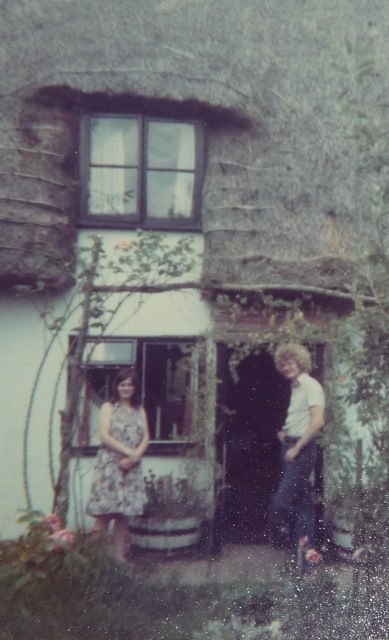
Back in the summer of 1980, before we were married, Mrs Bygone Boozer got herself a new job in Essex and had to find somewhere to live. She struck upon a house-share in a characterful thatched cottage in the village of Great Sampford. For characterful read cold, damp, rat-infested and with a bathroom roof which looked like it might come down at any moment. It eventually did!
On Friday evenings and Monday mornings one or other of us would make the journey up to Derby and then back down to Essex or vice versa. If she had headed north in her Renault 6 then we'd go out to the White Swan in Melbourne or the Chequers in Ticknall, both of which I'm please to tell you are still operating. If it was my turn to purr south in my fuel-injected Triumph, or chug down in my diesel Land Rover, then we'd go to the Bull in Great Sampford, which sadly is not.
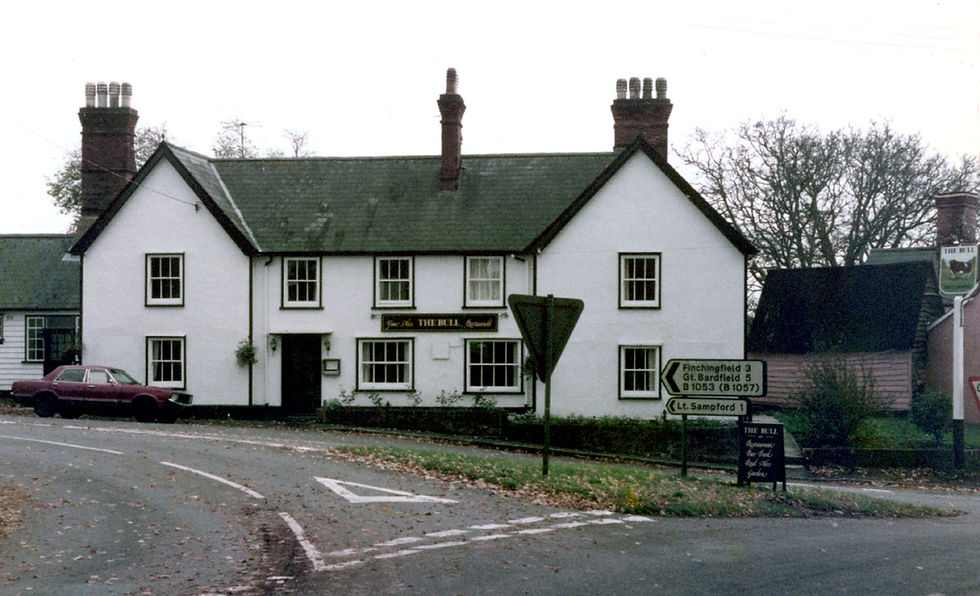
The earliest confirmed reference to the Bull, at times known as the Black Bull, that I've found is in a sale advert published in the Chelmsford Chronicle on 29th April 1795...

...although I have come across a comment on a genealogy site saying that "Steward Porter owned the Black Bull and left it to his son William Porter in his will in 1762."
The first regular appearance of the Bull in the usual sources is in Pigot's directory of 1839 which shows a Edmund Mascall there...

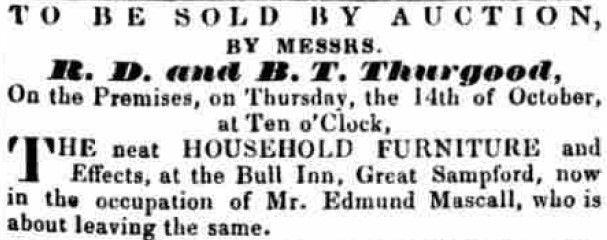
...as does the census taken in June 1841, when he was probably thinking of moving, for his stuff is advertised for sale in the Chelmsford Chronicle of 8th October.
He could well have been replaced by the first of a series of Williams. White's directory of 1848 lists a William Philpott at the Bull...

...and in 1856 he passes the pub's care on to William Tanner, as reported in the Essex Standard on 6th February.

By 1861 William Norris, along with his brother Henry, were pouring the pints...

...and it seems that they intended to celebrate Christmas well that year if this report from 17th Jan 1862 in the Chelmsford Chronicle is anything to go by.

Shortly after the census was taken, William married Bridget, his housekeeper, and by the time of the next headcount was a prison warden living in Islington. The Bull was now in the hands of one Joseph Davis...

...and when he died the licence was transferred to his widow, Sarah, as reported in the Essex Herald on 25th March 1873. Old Sampford was the village's old name.

Sarah stays on for a while...

...but by 1878 a John Osborn is there.

Relative or not, John wasn't there that long, for on Christmas Eve 1880 the Chelmsford Chronicle reported a change of licensee.

Charles was in it for the long haul. He was there when the Ordnance Survey mapped the village in 1896...

...when Kelly's representatives passed throuh the village in 1902...

...and possibly when this photograph of the pub was taken, sometime in the early 1900s.

Charles' wife, Sarah, died in 1904 and that might have been a trigger to retire, for in 1906 a different Charles was there.

He was still there at the time of the 1911 census but had gone the following year when Kelly tells us that John Tyrrell was at the Bull.

By 1937, when Raphael Tuck produced this hand-coloured postcard, the pub was one of Benskin's brewery of Watford's houses...

...and being run by Frederic Smith.

It was Benskin's bitter that I used to quaff there in the 1980s. Although Benskin's had been taken over by Ind Coope in 1957 and the Watford brewery demolished in 1979, having ceased production seven years earlier, in 1980 the beer was resurrected and brewed to the same recipe in Ind Coope's Romford brewery.
I last visited Great Sampford in September 2015 when Mrs Bygone Boozer and I took a rather convoluted and nostalgic route on the way to Cranfield University, as I had secured a ride in the National Circuit Time Trial Championship which was taking place there. My aims were quite simple: not to come last and to finish the twenty mile course without being caught and passed by Dame Sarah Storey.

As I was successful in achieving both objectives – just don't ask how many minutes ahead of Dame Sarah my start time was – it would've been nice to celebrate these minor achievements with a pint in the Bull for old times' sake, but that was not possible. Land Registry records suggest that it had closed by 1997. The building is now in residential use and known as Bull House.
![Mill [sic] House, Great Sampford in 2017. © J.Thomas](https://static.wixstatic.com/media/80023d_78f88e103a964ec793af8ad5914e353a~mv2.jpg/v1/fill/w_640,h_480,al_c,q_80,enc_avif,quality_auto/80023d_78f88e103a964ec793af8ad5914e353a~mv2.jpg)
It wasn't until I looked at the Ordnance Survey map, when preparing this piece, that I realised we would've passed another bygone boozer on our way to the then extant Bull. As the post's title suggests, I fully intended including the Cock in this post, but when I find a George Killingback working as a Tele-marketer rather than a tile maker in the nineteenth century I think it's time to curtail the census crawling. The Cock will appear in its own post sometime soon.
Thanks to John Law for the use of his photograph. J. Thomas's image of the Bull in 2017 is copyright and reused under this licence.
The Ordnance Survey map extract is copyright and has been reproduced with the permission of the National Library of Scotland under the terms of this CC BY licence.
The newspaper images are courtesy of the British Newspaper Archive (www.britishnewspaperarchive.co.uk).
If you've read this far, then thank you. Possibly, like me, you may have some sort of interest in bygone boozers. Clicking here will take you to a searchable/sortable index which you can use to see if I've already featured any lost locals from your locality. You can also subscribe to ensure that you don't miss any future posts. Simply click here to return to the home page (opens in a new tab), follow the 'Subscribe' link and complete the form to receive an email notification of any future post. Or you could simply follow the link at the top of this page.
©2026 www.bygoneboozers.co.uk


More great photos and research. Glad to report that the two Derbyshire pubs near me are still doing well.