Is This Another Swansong?
The Swedish summer sojourn is over. There were no further visits to 'Akuten' and the wasps nest caused no further issues. Mrs Bygone Boozer and I arrived at Manchester Airport to discover that the final heatwave of the summer was fading away. In fact, as we were headed along the A6, a few drops of dihydrogen oxide deposited themselves upon the windscreen.
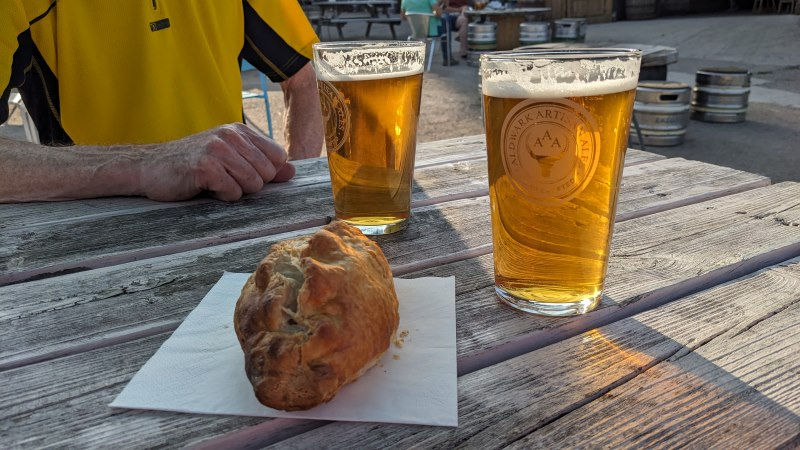
So it was back to Derbyshire. Derbyshire weather, Derbyshire hospital consultants (still no need for chemo, so life continues as normal, at least until the next blood tests in October) and Derbyshire pubs. The Duke of York, naturally, and a pedal or three to AAA's summer brewery tap at the farm.
It's back to Derbyshire too for this post. I have driven past the Black Swan on Wirksworth Road in Idridgehay hundreds of time on my way to and from various rock climbing venues in my younger days.

The building was classified as Grade II when it was given listed building status in 1967, with the details describing it as early 19th century. It's believed to date from 1827 and the first record of it that I've come across is in Glover's directory of 1829 when John Anable was listed as a victualler at the Black Swan.

He was still there in 1841, although the Swan had lost is colour...

...but by 1846 Bradshaw's directory lists a John Smith at the Swan and the Post Office one from three years later has Henry Bunting there.

Henry was away from home on census night 1851, staying in Beetwell Street in Chesterfield with his brother, whilst wife Ann looked after the pub...

...but it must've only been a temporary absence.
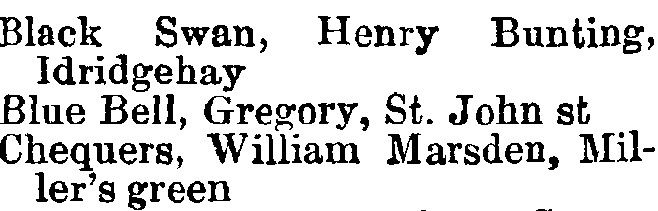
Henry and family moved to farm in Sutton-cum-Duckmanton, near Chesterfield and in 1855 we find William Lichfield at the Swan

In White's directory, published two years later, William had acquired a t in his surname and the Swan had regained its colour.

By the time of the 1861 census, a John Barton was living at the Swan.

The pub wasn't named, but we can be pretty sure that it was the Swan as John was there in 1871.

By 1881 the Swan had once again lost its colour and it had also lost John, who had died three weeks after the previous head count. His son, Joseph, was now running the pub.

By 1891, another John was at the Swan, John Burnett.

Mr Burnett died in July 1894 and when the census enumerator called once more, his widow Eliza was still pouring the pints, presumably aided by her widowed son-in-law, James Denny...

...for James is running the place with his new wife Mary, ten years later.

What happened to Eliza? She may have remarried, moved away, died or even been taken by aliens heading for the Barley Mow in Bonsall. Whatever it was, I can find no trace of her after 1901.
But I am a trifle confused. Whilst it appears that the Burnett/Denn(e)y pairing occupied the Black Swan from around 1891 to 1911, the Sheffield Daily Telegraph, on 11th March 1910, printed this piece on a legal judgement which suggested that at some point between 1908 and 1910 John William Dean was the tenant at the Black Swan.
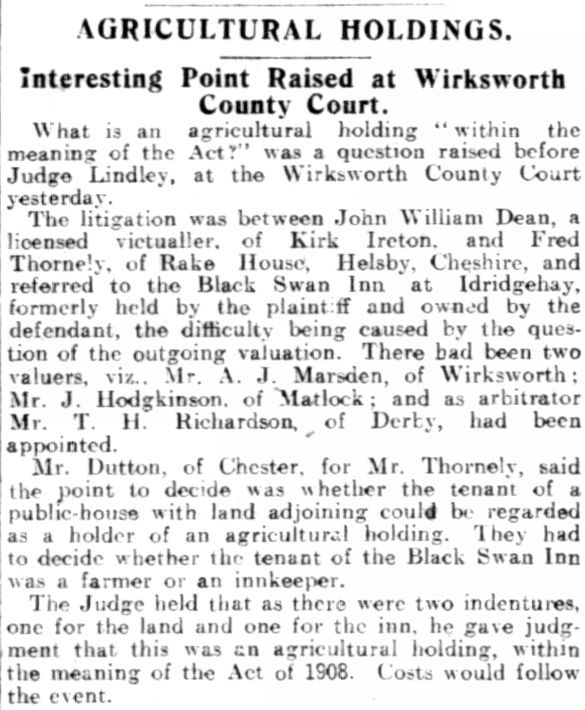
I do wonder if Mr. Dean was farming the land whilst sub-letting the pub. Whoever was in it, the pub looked like this around that time. Note that it's simply called the Swan, with room to repaint the word black to the left.

If I'm unsure who was running the Black Swan back then, I do know was doing so on my only visit to the place. Shortly after moving to the Derbyshire Dales, Mrs Bygone Boozer and I met up with some friends from the south of the county for a beer and a meal there, as it seemed a reasonable midway venue. Our hosts were Heather and John Ward who were there from 1980 to 1997. Memory has me supping Mansfield Bitter, but memory may well be mistaken after all these years. It certainly can't recall what I ate.
Heather and John retired from the licensed trade in September1997 and the pub was acquired by John Thornton, chairman of the chocolate company that was founded and eponymously named by his paternal grandfather. The Black Swan underwent an extensive renovation, including the kitchens, conservatory and garden before re-opening at lunchtime of 1st July the following year, with managers Julia and David Sandford in charge.
Over the years there has been a number of closures and re-openings, with the most recent closure coming in March 2024 after stated losses of tens of thousands of pounds per year. I was speaking to a couple of locals, a few weeks ago, who were hoping that it might reopen once again as a village pub, but I feel that with a planning application made for a change of use to a single residential property, just like the Swan Inn in Newton, this place has had its swansong...

...and no more will anybody eat at the sign of the Mucky Duck.

The newspaper image is courtesy of the British Library Board/British Newspaper Archive.
If you've read this far, then thank you. Possibly, like me, you may have some sort of interest in bygone boozers. Clicking here will take you to a searchable/sortable index which you can use to see if I've already featured any lost locals from your locality. You can also subscribe to ensure that you don't miss any future posts. Simply click here to return to the home page (opens in a new tab), follow the 'Subscribe' link and complete the form to receive an email notification of any future post. Or you could simply follow the link at the top of this page.
©2026 www.bygoneboozers.co.uk


A few of us would stop here occasionally in the 80s or early 90s, whilst on our way to or from the Barley Mow at Kirk Ireton on motorbikes. It had a good pool table, which was the main attraction. The last time was on a very cold day in March 2018 by train on the Ecclesbourne Valley Railway, which runs in the valley behind the pub. Some friends who went more recently were not impressed by the standard of food or service!
Tim in Belper